

Stephen Downes

Knowledge, Learning, Community

Please select a newsletter and enter your email to subscribe.

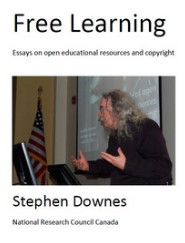
Stephen Downes spent 25 years as an expert researcher at the National Research Council of Canada, specializing in new instructional media and personal learning technology. With degrees in Philosophy and a background in journalism and media, he is one of the originators of the first Massive Open Online Course, has published frequently about online and networked learning, and is the author of the widely read e-learning newsletter OLDaily. He is a popular keynote speaker and has presented at conferences around the world. [More]

Support OLDaily

OLDaily has been free and open to all readers since 2001. It is a valuable and widely-used resource for educators, researchers, and learners worldwide. Please consider a monthly contribution to sustain the time and resources required to publish it every day.


Here's what's in the latest edition of OLDaily

Are Memories Transferable - or Edible?
79394 image icon

This is a great article showing some of the twists and turns that can happen to researchers studying memory. The bulk of the article describes the work of James McConnell, who "convinced the scientific establishment that planarian worms, like Pavlov's dogs, could be classically conditioned - and that memories of this training could be transferred from worm to worm through cannibalism." While his students swore the worms could be trained, efforts to replicate failed, and the work - and the theory - languished in obscurity. More recently, however, Princeton University geneticist Coleen Murphy found a retrotransposon, a jumping segment of genetic material, called Cer1, that appears to "carry a memory " between individuals. So maybe there was something to McConnell's work.

Today: Total: Claire L. Evans, Quanta Magazine, 2026/06/10 [Direct Link]


Multimodal Browser AI with Transformers.js for Images and Speech
79393 image icon

This is the sort of thing I really like AI for: "In this article, you will learn how to build multimodal AI capabilities - image classification, image captioning, and speech transcription - that run entirely in the browser using Transformers.js, with no server, no API key, and no data leaving the user's device." I'm linking this here for mostly my own purposes, though it's going to be a few months before I will be able to get back to writing code again.

Today: Total: Shittu Olumide, MachineLearningMastery.com, 2026/06/10 [Direct Link]
Advancing Federated Identity in the Library Ecosystem
79392 image icon

The intent of this post is to argue for federated identity as a mechanism for library access. The idea of federated identity is that individual institutions authenticate their own members, and then this authentication is shared across participating institutions - a federation - to provide member access to services offered by all of them. That sounds great, but of course what bothers me about this is the idea that people would need itentity and authentication management (IAM) to access library sevrices at all. The need is created by the existennce of resticted access collections - commercial products that have granted libraries only limited licenses to share. But maybe this is beginning to change. "Scholars increasingly encounter content through open web pathways and AI-assisted discovery tools, rather than beginning within library-managed environments. Many authentication models still common across scholarly publishing are therefore increasingly misaligned with how research actually happens."

Today: Total: Amanda Ferrante, The Scholarly Kitchen, 2026/06/10 [Direct Link]
Sad Professors
79391 image icon

During yet another presentation in which the dangers and shortcomings of AI were being presented, once again from the perspective of teachers who really felt their students need to be warned, I wondered aloud why they weren't also sharing what could be done with AI. And of course it has in part to do with the fact that the affordances of AI cut across the workflow of the average instructor like a power saw across thin cardboard. And so the despair of teachers and professors is not surprising. And I had to ask myself, what would I do in their shoes. Put my own assignment though the AI and share the result with the class? As one person suggested, that would show how much my assignments need to be changed. But what I'd probably do is share my exploration of my subject with the AI with the class. Doing a logic class? Let's see how the AI does on argument analysis. Writing up lab results? Let's see that the AI does with that - and let's see what it suggests as an experiment. 

Today: Total: Steven D. Krause, 2026/06/10 [Direct Link]
It's not enough to have better ideals.
79390 image icon

Ben Werdmuller's argument here is that, in addition to supporting your ideals, your product needs to serve a core purpose (sometimes called a 'pain point'), and this is demonstrated via the product's sustainability model. This applies, he says, even if the product is government funded. "Sustainability isn't a thing you think about after you've designed a product. Your product's business model is an integral part of it: whether your solution is valuable or not to a user depends in large part on the business model you use to provide it." I've thought a lot about this over the years. In the main, he is right, but I think that in some key areas the business models don't align with the pain points - the pain is too localized, or felt only by people without means, or won't be felt until the future. Business models depend on people with wealth, and ultimately support the interests of people with wealth. Sustainability can't just be based on business models. What would work (in my view) to support open source software, for example, would be a society where people don't have to support themselves by being paid for work. Getting from here to there, of course, is no easy task. But we begin by understanding that we need not be locked into a system where 'business models' trump all else.

Today: Total: Ben Werdmuller, 2026/06/10 [Direct Link]
Wittgensteinian Language Games & Generative AI
79389 image icon

This is a nice set of presentation slides, written by Gamma.app, probably at the instigation of Michael Peters. You could just skip it if you won't look at AI-generated content, but I think you'd be missing out. If you're not familiar with Wittgenstein, especially with respect to how his work bears on AI, it's a great introduction. If you are familiar with his work, and in particular Saul Kripke's interpretation of Wittgenstein on rules, then you're missing out on the opportunity to see how the AI has missed both the background for Kripke's reading and the criticisms of the 'Wittgenstein as sceptic' approach. Wittgenstein uses the word 'rule', but the idea that a rule expresses some sort of negotiated social agreement of a binding or normative principle would, in my view, be mistaken.

Today: Total: Gamma.app, 2026/06/10 [Direct Link]

Stephen Downes Stephen Downes, Casselman, Canada
stephen@downes.ca

Copyright 2026
Last Updated: Jun 11, 2026 12:37 a.m.

Canadian Flag Creative Commons License.